WITHIN · FIELD GUIDE · Revised September 1, 2026
How a watch should fit: the numbers
Case diameter is the number on the spec sheet. Lug to lug is the number on your wrist.
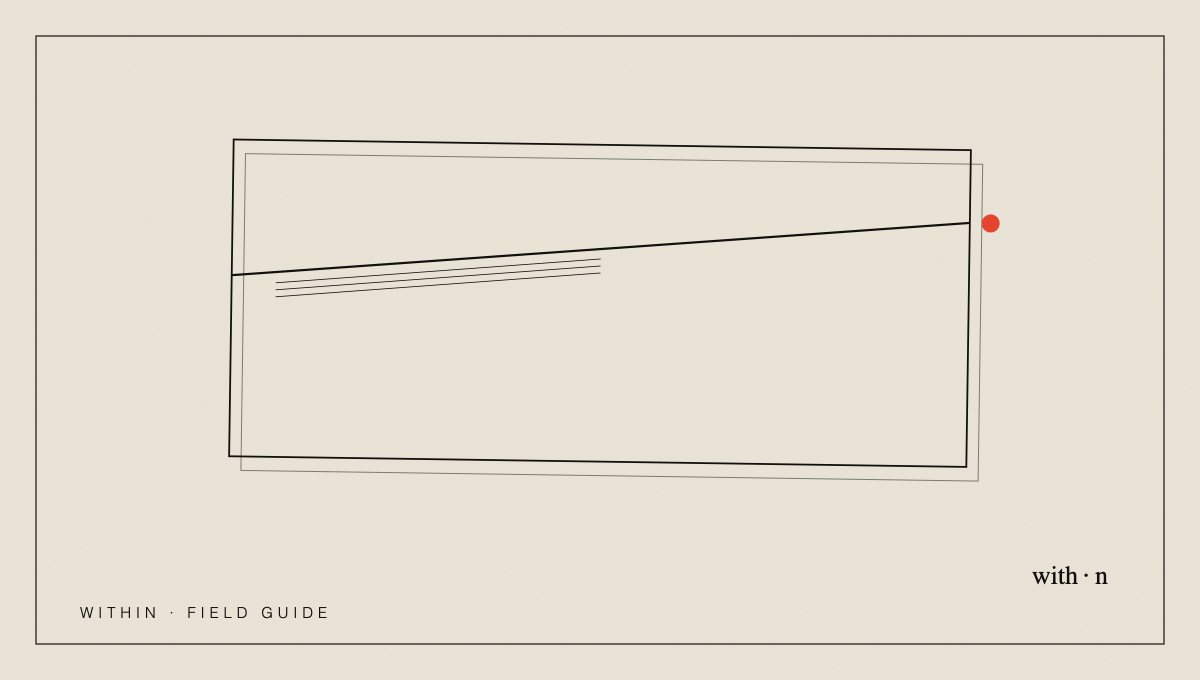
The rule that settles it
Lug to lug is the span from lug tip to lug tip, the full length the case occupies down your wrist. The rule: that span must not pass the flat top of your wrist. When it does, the lugs hang into air, the case bridges instead of sitting, and the head rolls toward whichever side the day tilts it. Diameter cannot warn you about any of this, because two cases with the same diameter can differ by several millimetres of lug. Overhang is the whole failure.
Measure the wrist, both ways
Wrap a flexible tape where you actually wear the watch, usually just past the wrist bone, snug enough to stay put and no tighter, and read the circumference. No tape: wrap a strip of paper, mark where it meets, lay it on a ruler. Then the second number, the one most people skip. Lay a ruler flat across the top of the wrist and read the width of the flat, ignoring where it curves away. That width is your lug to lug budget. Wrists run a little bigger in heat, so measure on an ordinary afternoon rather than out of a cold shower.
Diameter bands, held loosely
Convention, and it is only convention: wrists under about 16.5 cm, which is six and a half inches, tend to carry cases of 34 to 38 mm well; between there and about 18.5 cm the usual answer is 36 to 40; above that, 40 and up stops looking large. These are where most people land, not where you must. A curved case with short lugs wears smaller than its diameter, a flat case with long lugs wears larger, and the lug to lug check outranks every band in this paragraph.
Lug width, and the straps you have not bought yet
Lug width is the gap between the lugs where the strap mounts, in millimetres. Even numbers, 18, 20, 22, and on bigger cases 24, are what most straps are cut for; odd widths, 19 and 21, common on older watches, narrow your choices to the makers who bother. Quick release spring bars let you swap without tools, and drilled lugs, a small hole through the outside of each lug, make even ordinary bars painless. A watch you can restrap is several watches.
Thickness, under a cuff
Thickness decides whether the watch lives with your shirts. As convention has it, around 10 mm and under slides beneath a buttoned cuff without negotiation; by 12 or 13 the cuff rides up and the watch spends the day announcing itself. Nobody standardises where that measurement starts, and a domed crystal or a deep caseback can move it by a millimetre or three, so ask what the number includes before you trust it against a cuff. Shape moves the felt number too: curved lugs and a rounded back wear thinner than slab sides at the same measurement.
Questions to ask at the counter
- What is the lug to lug?
- What is the thickness with the crystal included?
- What is the lug width, and is it an even size?
- Are the spring bars quick release, and are the lugs drilled?
- Can the bracelet reach my exact circumference, with half links or an adjustable clasp?
Numbers shortlist, wrists decide
Carry the two wrist numbers in your phone and read every spec sheet against them; when the shortlist is ready to meet daylight, the journal keeps a note on buying a watch in Toronto. A watch that fits disappears by ten in the morning. The wrong lug to lug reaches across the table before you do.